
Bacterial cellulose (BC) is a biopolymer produced by certain bacteria, offering unique properties such as high purity, strength, flexibility, and biocompatibility. Unlike plant-derived cellulose, BC is free from lignin and hemicellulose, making it exceptionally versatile for industrial applications.
Our laboratory conducted a comprehensive review in collaboration with Universidad de las Américas (UDLA) researchers, María Alejandra Cruz, Omar Flor Unda, and Alex Ávila, that highlights the evolving technologies and methodologies advancing bacterial cellulose (BC) production and its expanding impact across diverse industries. As a high-value biopolymer, BC is celebrated for its versatility, sustainability, and broad applications—from wound dressings to biodegradable food packaging.
We focused on recent advancements in scaling up BC production, a crucial area given the need for efficient, sustainable, and large-scale production processes. A critical analysis of different bacterial production systems and bioreactor designs offers insights into the parameters that most significantly affect production efficiency, such as strain selection, oxygen availability, temperature control, and scalability. Additionally, our lab has explored how genetic engineering is enhancing BC synthesis, particularly by optimizing strains like Komagataeibacter xylinus, to improve productivity and adapt to industrial demands.
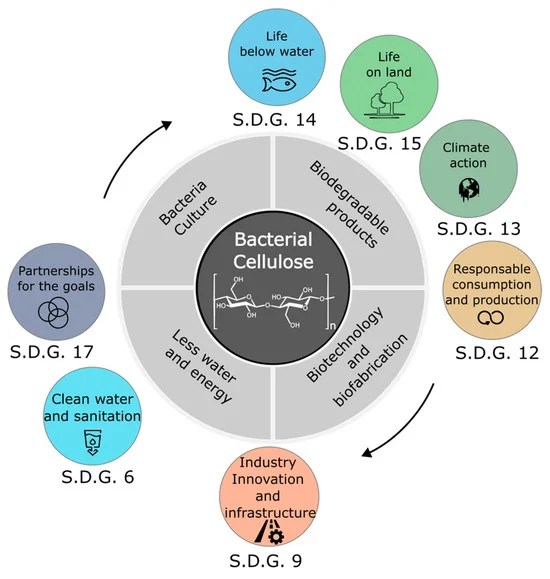
Beyond its technical focus, our review also touches on the broader social impact of BC production. The versatility of BC aligns closely with the United Nations Sustainable Development Goals (SDGs), particularly those targeting responsible consumption, sustainable industry, and climate action. For example, BC-based materials can reduce reliance on non-renewable resources, support circular economy practices by utilizing agricultural waste, and lower environmental impacts through biodegradable alternatives to conventional plastics.
Through this publication, our laboratory aims to contribute a synthesized reference on current BC production techniques, challenges, and future directions. We hope our findings not only advance research but also foster collaboration among industry, academia, and government, propelling bacterial cellulose research into new applications and sustainable innovations.
The review, entitled «Advances in Bacterial Cellulose Production: A Scoping Review», was published in the journal Coatings and is available online (open-access) at https://www.mdpi.com/3027554
 Molecular Biology and Applied Biotechnology Lab